Understanding the FMCSA 70/8 Rule
For OTR (Over-the-Road) truck drivers in the US, strict compliance with the FMCSA Hours of Service (HOS) regulations is critical. The "70-hour/8-day" rule is the most common operational limit for carriers moving freight every day of the week. If your logs involve converting standard clock times to 24-hour DOT logs, you can utilize our military time converter to ensure accuracy.
🚛 The Limit: You cannot legally drive a commercial motor vehicle (CMV) after having been on duty for 70 hours in any 8 consecutive days.
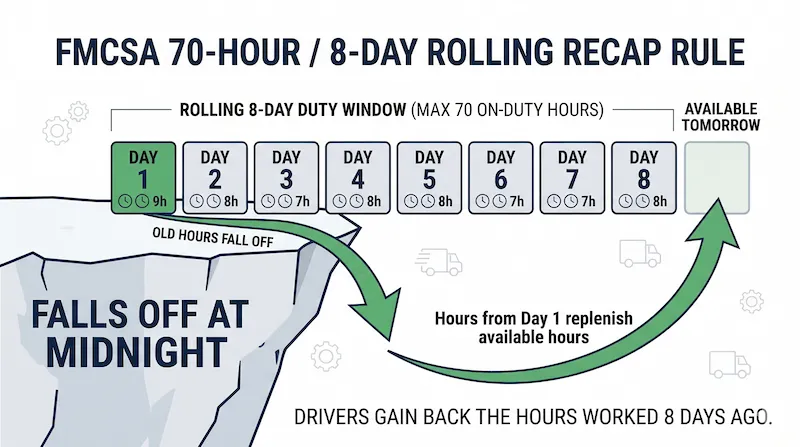
🔄 The Rolling Window: This is not a fixed calendar week (like Sunday to Saturday). It is a "rolling" 8-day period that shifts forward by one day every midnight.
⏱️ The Reset: You can completely reset your 70-hour clock back to zero at any time by taking 34 consecutive hours completely Off-Duty or in the Sleeper Berth.
How to use our 70 hour 8 day recap calculator
A reliable 70-hour recap calculator helps you easily track your rolling hours to avoid severe DOT violations. Before using this tool, make sure your logbook times are calculated in standard decimals (e.g., 8 hours 30 mins = 8.5 hours). You can quickly convert your minutes using our decimal hours calculator.
By simply entering your last 8 days of On-Duty and Driving hours into the fields above, the tool automatically sums up your accumulated time. Most importantly, it calculates exactly how many hours will "fall off" at midnight, revealing how much driving time you get back the next day for dispatch planning.
| Log Day | Actual Date | Hours Logged | Status at Midnight |
|---|---|---|---|
| Day 1 | Oct 1st | 9.5 Hours | Falls off tonight (You gain 9.5 hours tomorrow) |
| Day 2 | Oct 2nd | 10.0 Hours | Becomes the new "Day 1" tomorrow |
| Day 3 | Oct 3rd | 11.0 Hours | Rolls forward |
| Day 4 | Oct 4th | 8.5 Hours | Rolls forward |
| Day 5 | Oct 5th | 10.0 Hours | Rolls forward |
| Day 6 | Oct 6th | 9.0 Hours | Rolls forward |
| Day 7 | Oct 7th | 5.0 Hours | Rolls forward |
| Today (Day 8) | Oct 8th | 0.0 Hours | Total of Days 1-8 cannot exceed 70.0 |
70 hour 8 day vs 60 hour 7 day rule: Which applies to you?
The main difference between the 70 hour 8 day vs 60 hour 7 day limit depends entirely on your motor carrier's operating schedule.
- 70-Hour / 8-Day: Applies if your trucking company operates vehicles every single day of the week (7 days a week). This is standard for almost all OTR operations.
- 60-Hour / 7-Day: Applies only if your company does not operate vehicles every day (for example, a local delivery fleet running only Monday through Friday).
Understanding the 70 hour 8 day rule reset (34-Hour Restart)
If you are running out of available hours on your recap (burning close to your 70 limit), you can utilize the FMCSA 34-hour restart provision. By taking 34 consecutive hours completely Off-Duty, in the Sleeper Berth, or a combination of both, your 70-hour clock instantly drops back to zero, giving you a completely fresh 70 hours to work with for your next operational cycle.
How does a 70 hour 8 day split sleeper affect your recap?
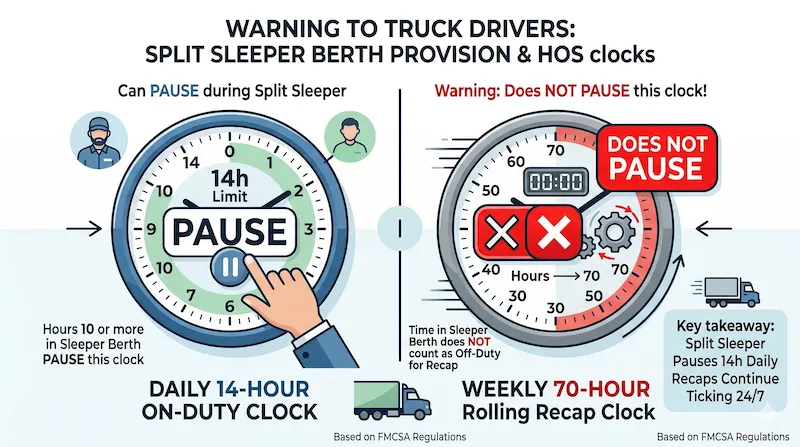
Many drivers are confused about how the split sleeper berth provision (such as an 8/2 or 7/3 split) affects their weekly rolling recap. It is crucial to understand that while using the split sleeper provision allows you to pause your daily 14-hour driving window, it does not pause or extend your 70-hour/8-day clock. Every single hour spent On-Duty or Driving still accumulates toward your 70-hour weekly limit, regardless of how you split your sleeper time.