Does Oregon Have Daily Overtime? (The 10-Hour Rule)
For most regular office, retail, and service workers, Oregon follows the standard federal rule: overtime is only paid after 40 hours in a workweek. However, Oregon has a highly specific daily overtime law (ORS 652.020) that applies strictly to a massive blue-collar sector.
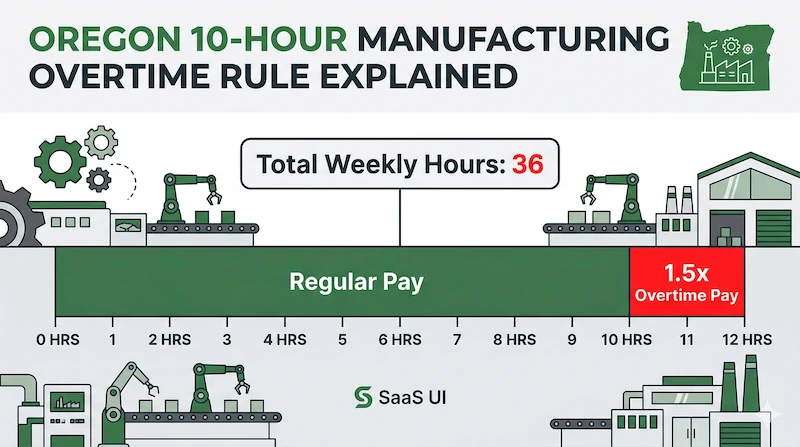
If you work in a manufacturing establishment, mill, or cannery, your employer must pay you time-and-a-half (1.5x) for any hours worked over 10 in a single day.
"The 13-Hour Hard Limit: Under Oregon law, it is generally illegal for a mill or manufacturing worker to work more than 13 hours in any 24-hour period unless there is a true, verifiable emergency."
The "Greater Of" Rule: Daily OT vs Weekly OT
Like Alaska and Colorado, Oregon prevents "pyramiding" (double-counting overtime). Employers are not allowed to pay you daily overtime AND weekly overtime for the same exact hour of work.
If you check the "Manufacturing" box in our calculator, it will calculate your overtime owed under the daily 10-hour rule, then calculate it under the standard weekly 40-hour rule, and automatically award you whichever amount pays more.
| Calculation Method | Regular Hours | Overtime Hours (1.5x) |
|---|---|---|
| Standard Federal FLSA (Weekly > 40) | 36 Hours | 0 Hours |
| Oregon Manufacturing Rule (Daily > 10) | 30 Hours | 6 Hours (3 shifts x 2 OT hrs) |
Oregon's Tiered Minimum Wage (2026)
Oregon is unique because its minimum wage is determined by exactly where your job is located within the state. The state uses a three-tier geographic system, adjusted annually on July 1st:
- Portland Metro: The highest rate in the state.
- Standard Counties: The baseline rate covering most of the state.
- Non-Urban Counties: A slightly lower rate for rural areas.
Oregon does not allow a "tip credit." This means employers cannot pay tipped workers (like waiters and bartenders) less than the full state minimum wage. You get your full hourly wage plus all your tips.