The "48 vs 40" Overtime Conflict Explained
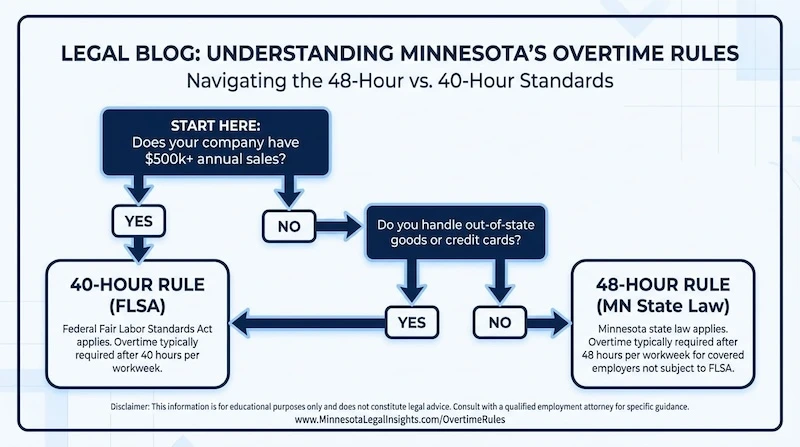
Minnesota labor law is unique and often confusing for both workers and managers. Under the Minnesota Fair Labor Standards Act, employers are only required to pay 1.5x overtime after 48 hours worked in a week.
However, the Federal FLSA (which applies to any business grossing over $500,000 or engaging in interstate commerce) mandates overtime after 40 hours. Since federal law usually trumps state law when it is more protective, the vast majority of Minnesota workers are legally entitled to overtime after 40 hours.
2026 Minnesota Minimum Wage Tiers
Minnesota adjusts its minimum wage every January 1st based on inflation. For 2026, the rates are split into two categories based on employer size:
- Large Employers: Approximately $11.33/hr (Annual gross volume of $500,000 or more).
- Small Employers: Approximately $9.25/hr (Annual gross volume under $500,000).
| Employer Size | Min Wage | OT Threshold | Tip Credit Allowed? |
|---|---|---|---|
| Large (>$500k) | $11.33 | 40 Hours (Federal) | NO |
| Small (<$500k) | $9.25 | 48 Hours (State) | NO |
Tipped Workers: Minnesota's Ban on the Tip Credit
Unlike most states, Minnesota strictly prohibits the "Tip Credit." This means that even if you are a server or bartender earning hundreds in tips, your employer must pay you the full state minimum wage ($11.33 or $9.25) for every hour worked. Tips belong 100% to the employee and cannot be used to satisfy the employer's minimum wage obligation.