The Unique Kentucky "7th Day" Overtime Law (KRS 337.050)
If you work in Kentucky, you have access to a powerful labor protection that doesn't exist in most other U.S. states. While Kentucky generally follows the federal Fair Labor Standards Act (FLSA), it has a unique addition: The 7th Day Overtime Rule.
"Under Kentucky statute KRS 337.050, if an employer permits you to work seven consecutive days in a single workweek, and your total hours for the week exceed 40, they must pay you time-and-a-half (1.5x) for all hours worked on the seventh day."
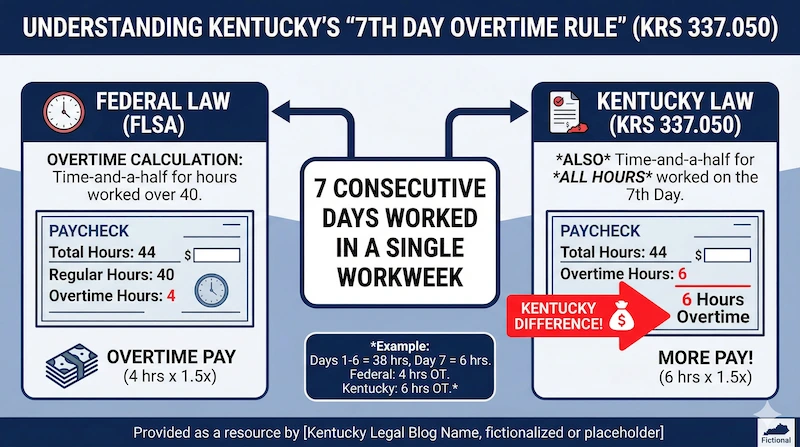
How to Calculate FLSA Overtime vs. Kentucky State Law
Why does this 7th-day rule matter so much? Because in certain scenarios, the Kentucky state law overrides the federal FLSA calculation and puts more money in your pocket.
Normally, a standard weekly overtime calculator only grants 1.5x pay for hours that cross the 40-hour threshold. But look at the scenario below to see how Kentucky calculates it differently:
| Calculation Method | Regular Pay Hours | Overtime Pay Hours (1.5x) |
|---|---|---|
| Standard Federal FLSA | 40 Hours | 4 Hours (Only hours over 40) |
| Kentucky Law (KRS 337.050) | 38 Hours | 6 Hours (All Day 7 hours are OT) |
*Note: The Kentucky 7th Day Rule only activates if your total working hours for the week actually exceed 40. If you work 7 days but only total 30 hours, no overtime is required.
Minimum Wage and Tipped Employees in KY (2026)
Unlike neighboring states that have raised their base wages, Kentucky generally defaults to the federal minimum wage of $7.25 per hour. There is currently no state legislation raising this rate for 2026.
For service industry workers, the tipped minimum wage in Kentucky is $2.13 per hour. However, if your tips plus the $2.13 do not equal at least $7.25 per hour, the employer must make up the difference. If you are calculating complex payroll shifts involving minutes, use a decimal hours converter to ensure your timesheet submissions are highly accurate.
Mandatory Rest Breaks and Meal Periods in Kentucky
Kentucky is also generous regarding breaks. By state law, employers must grant:
- A paid 10-minute rest break for each four hours worked.
- A reasonable meal period (usually 30 minutes, unpaid) close to the middle of the employee's scheduled shift.