Time & Material (T&M) Tracking for Electrical Contractors
Unlike standard 9-to-5 office jobs, electrical work involves complex billing structures. You aren't just selling your time; you are selling parts, specialized travel, and high-liability expertise. That's why a standard punch-clock timesheet is never enough. While you can use our weekly time card generator to track basic payroll hours, client-facing service calls require a dedicated Time and Material (T&M) Work Order.
How to Bill for Labor: Master vs. Apprentice Rates
A professional electrical contractor rarely bills out all labor at a flat rate. A service ticket might involve a Master Electrician diagnosing a fault, while an Apprentice pulls the Romex wire. Your timesheet must reflect these tiered rates.
Pro Tip: When filling out the "Labor Hours" section in the tool above, make sure you convert your time into decimals rather than standard minutes (e.g., 1 hour and 15 minutes should be entered as 1.25 hours). If you need help with this conversion, use our decimal hours calculator before generating your PDF invoice.
Stop Losing Money on Parts: The Material Markup Rule
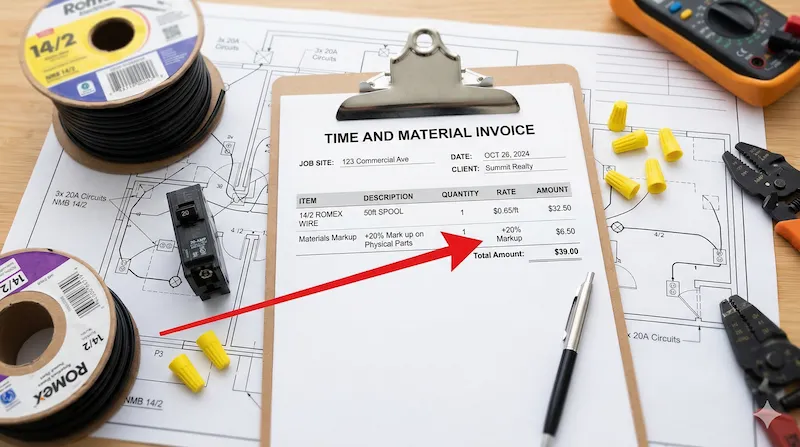
One of the biggest leaks in an independent electrician's profit margin is failing to track small stock items. It is incredibly easy to forget that $50 GFCI breaker or the 50ft of 12/2 wire you pulled from the van.
"If you buy a receptacle for $3.00 at the supply house, you should not be billing the client $3.00. You must account for the time spent driving to the supply house, storing it in your van, and inventorying it."
Standard industry practice dictates a Material Markup. Most electrical contractors apply a 15% to 30% markup on wholesale parts. When using our Work Order generator above, ensure the "Unit Cost" you input already includes your desired profit margin to prevent "sticker shock" when the client sees the final tally.
Prevailing Wage & Union Compliance (IBEW)
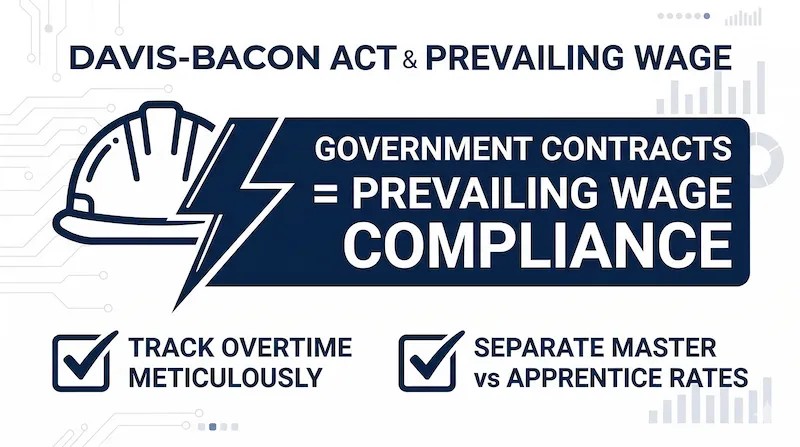
If you are a member of the IBEW (International Brotherhood of Electrical Workers) or if you are working on a federally funded government project, your timesheets are subject to strict scrutiny under the Davis-Bacon Act. This means you must accurately track the "Prevailing Wage" for your specific county.
Furthermore, union contracts often have unique overtime rules (such as double time on Sundays). If you are tracking premium pay hours that need to be separated on the invoice, we highly recommend running your shifts through our overtime calculator to ensure your multipliers are perfectly compliant before asking the customer for a signature.