Does Colorado Have Daily Overtime? (The 12-Hour Rule)
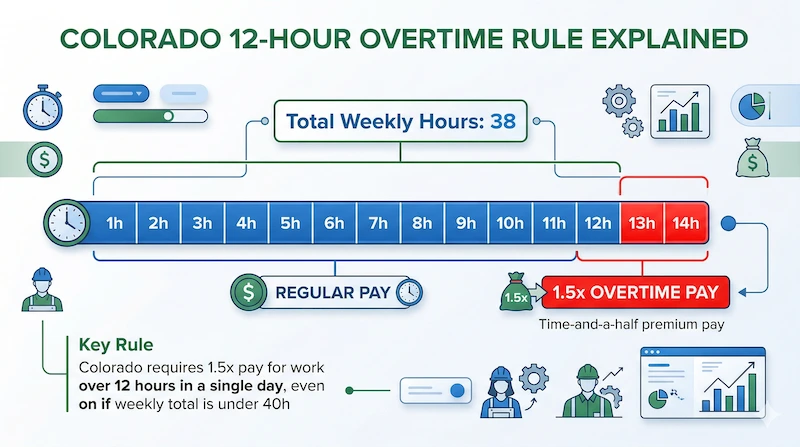
Yes. While most states only follow the federal 40-hour workweek rule, Colorado labor law provides strict protections for workers pulling long shifts. Under the Colorado Overtime and Minimum Pay Standards (COMPS) Order, employers must pay time-and-a-half (1.5x) for any work that exceeds:
- 12 hours per workday (a 24-hour period defined by the employer), OR
- 12 consecutive hours (even if the shift spans across two different calendar days).
"If you work a 14-hour shift in Colorado, you are guaranteed at least 2 hours of overtime pay, regardless of whether you hit 40 hours by the end of the week."
FLSA Weekly vs. Colorado Daily Overtime (Which Pays More?)
In Colorado, you evaluate both your daily overtime (hours over 12 in a day) and your weekly overtime (hours over 40 in a week). However, state law prohibits "pyramiding" or duplicating overtime. Your employer must calculate both and pay you whichever amount is greater.
| Calculation Method | Regular Hours | Overtime Hours (1.5x) |
|---|---|---|
| Standard Federal FLSA (Weekly > 40) | 40 Hours | 2 Hours |
| Colorado COMPS Rule (Daily > 12) | 36 Hours | 6 Hours (3 shifts x 2 OT hrs) |
In the scenario above, our calculator will automatically apply the Colorado state rule because it grants you 6 hours of overtime instead of just 2. If you are calculating complex payroll shifts involving minutes, use a decimal hours converter to ensure your timesheet submissions are highly accurate before checking for the 12-hour threshold.
Colorado Minimum Wage & Missed Break Penalties
Colorado consistently maintains one of the higher minimum wages in the country, adjusted annually for inflation. For 2024, the statewide minimum wage was $14.42, with cities like Denver establishing even higher local minimums. Tipped employees can be paid up to $3.02 less per hour, provided their tips make up the difference.
The Rest Break Penalty: Colorado is incredibly strict about rest periods. The COMPS Order requires a 10-minute paid rest break for every four hours worked. If an employer fails to authorize this break, it counts as time worked, and the employer owes you an additional 10 minutes of compensation for each missed break.