Why Use CountWorkHours.com?
Our Free Time Card Calculator is built for the modern workforce. We provide a simple, fast, and compliant way to accurately track your time.
- ✅ Count work hours instantly across a full 7-day week.
- ✅ Calculate exact decimal durations to verify your paycheck.
- ✅ Generate a clean, payroll-ready PDF timesheet for your employer.
📱 Mobile First
Designed for phones. Big buttons, easy scrolling, and no tiny spreadsheet cells.
⚡ Smart Input
Type "8" for 8:00 AM or "5p" for 5:00 PM. The system understands you.
🍱 Auto-Deduct Lunch
Automatically subtracts unpaid break times (default 30 mins) from daily totals.
🔒 Privacy First
Data is processed locally on your device. We never see your hours.

Easily count work hours directly from your phone, whether at your desk or on the job site.
Understanding Decimal Hours for Payroll
Most payroll systems (including ADP, Paychex, and QuickBooks) require hours to be reported in decimal format to calculate wages accurately. For example, 8 hours and 30 minutes must be entered as 8.50 hours so your hourly rate multiplies correctly.
Minutes to Decimal Conversion Chart
| Minutes Worked |
Decimal Equivalent |
Payroll Calculation Example (at $20/hr) |
| 15 Minutes |
0.25 Hours |
0.25 × $20 = $5.00 |
| 30 Minutes |
0.50 Hours |
0.50 × $20 = $10.00 |
| 45 Minutes |
0.75 Hours |
0.75 × $20 = $15.00 |
| 60 Minutes |
1.00 Hour |
1.00 × $20 = $20.00 |
US Labor Laws & Overtime Rules
Under the Fair Labor Standards Act (FLSA), non-exempt employees in the United States must receive overtime pay for hours worked over 40 in a workweek at a rate not less than time and one-half their regular rates of pay.
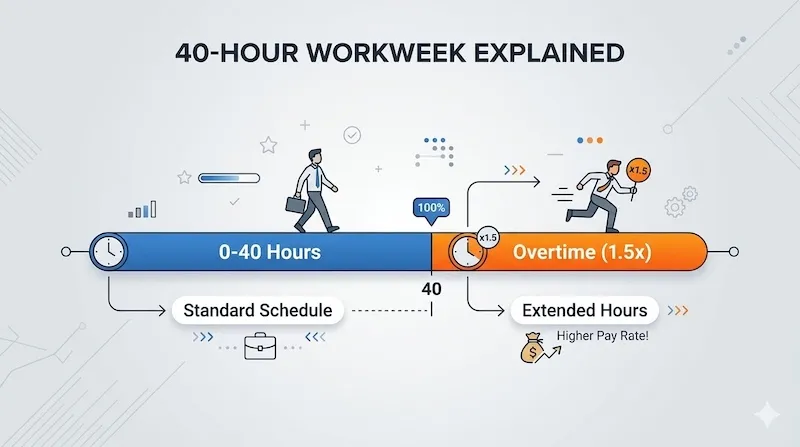
Federal law mandates 1.5x pay for any hours counted over the 40-hour weekly threshold.
Our calculator helps you track your total weekly hours to ensure you are being paid correctly for any overtime worked. Note that some states, like California, have daily overtime rules (over 8 hours in a day) which differ from federal standards.
Timesheet Rounding Guidelines
Many employers use the "7-Minute Rule" for rounding clock-in and clock-out times. According to the Department of Labor (DOL), employers may legally round employee time to the nearest quarter-hour (15 minutes).
| Actual Clock In Time |
Rounding Rule Applied |
Time Recorded For Payroll |
| 8:05 AM |
01 - 07 mins (Round Down) |
8:00 AM |
| 8:08 AM |
08 - 14 mins (Round Up) |
8:15 AM |
| 8:22 AM |
16 - 22 mins (Round Down) |
8:15 AM |
While this tool calculates your exact time minute-by-minute, be aware that your official paycheck may reflect these standard rounding practices.
Frequently Asked Questions
1. How do I calculate 8 hours and 30 minutes?
You convert the minutes to a decimal by dividing by 60. So, 30 minutes divided by 60 equals 0.5. Therefore, 8 hours and 30 minutes is recorded as 8.5 hours for payroll purposes.
2. Is my lunch break paid or unpaid?
Under federal law, bona fide meal periods (typically 30 minutes or more) are generally not compensated as work time. Our calculator allows you to enter 30 in the Break column to automatically deduct this unpaid time from your daily total.
3. How does the 7-minute rounding rule work?
Employers are allowed to round time to the nearest 15-minute increment. If you clock in at 9:07, it rounds to 9:00. If you clock in at 9:08, it rounds to 9:15. This rule must be applied impartially (it cannot only favor the employer).
4. How is overtime calculated in California vs. Federal law?
Federal law only requires overtime after 40 hours in a week. However, California requires overtime pay (1.5x) for any hours worked over 8 hours in a single day, regardless of the weekly total. Double time applies after 12 hours in a day.
5. What is the difference between Bi-Weekly and Semi-Monthly pay?
Bi-Weekly means you are paid every two weeks (26 paychecks per year). Semi-Monthly means you are paid twice a month (24 paychecks per year), usually on the 1st and 15th. This calculator is designed for Weekly tracking, but you can use our Bi-Weekly Calculator for two-week cycles.